A Room-by-Room Home Safety Checklist for Aging Parents
Most falls happen on a short list of routes, not everywhere at once. Here is what to check, in the order that actually changes the risk.
Every home safety checklist you find online has about forty items on it. Most of them do not matter for your parent. Two or three of them matter enormously, and which two or three depends entirely on the route your parent walks every day.
So start there. Not with the list, with the route.
Map the actual route first
Walk the path your parent takes between the bed, the bathroom, the kitchen, and the front door. Then walk it again at night, with the lights they actually use. Nearly every fall we see falls into one of three buckets: the trip to the bathroom in the dark, the bathroom itself, and the steps at an exterior door.
Everything below is organized around those three moments.
The bedroom and the night route
- A lamp within reach of the bed, plus a plug-in nightlight between the bed and the bathroom door. Motion-sensing nightlights cost very little.
- A clear floor. Rugs with curled edges come out. So does the chair that lives in the walkway.
- A phone, or a medical alert pendant, within reach of the bed rather than across the room.
- Bed height: if your parent's feet do not sit flat on the floor when they are sitting on the edge of the bed, the bed is too high.
- A bedside table that is stable enough to lean on when standing up.
The bathroom
This is where the most consequential fixes live, and where the most bad advice circulates.
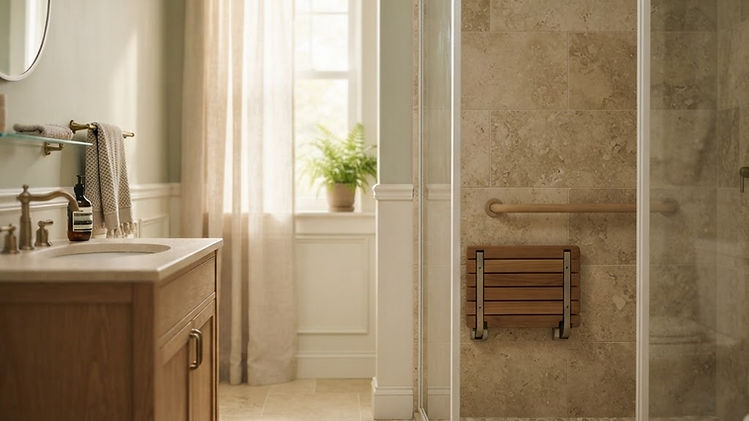
- Grab bars, anchored into wall blocking. Suction cup bars are not grab bars and they fail at exactly the wrong moment. Towel bars are not grab bars either, no matter how solid they feel.
- A shower chair and a hand-held shower head, so nobody is standing on wet tile with their eyes closed.
- A non-slip mat inside the tub or shower, and a bath mat with a rubber backing outside it.
- A comfort-height toilet, or a properly installed raised seat. The stand-to-sit motion is the one that fails first.
- Door width. If a walker is coming, measure the doorway before you buy anything else.
- Light. A bathroom that is dim at 2 a.m. is a different room than the one in the listing photos.
Stairs and hallways
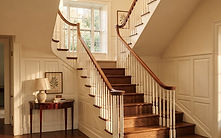
- Handrails on both sides, continuous from the bottom step to the top, with no gaps at the turns.
- Contrast tape or a painted stripe on the top and bottom step. Depth perception flattens with age, and a step that does not read as a step is a fall.
- Loose treads, worn carpet, and anything sitting on the stairs. Stairs are not storage.
- When the stairs themselves become the barrier, a stairlift or moving the bedroom downstairs are the two real options. We wrote about what a stairlift costs in Massachusetts separately.
The kitchen
- Move the daily items, the coffee, the cereal, the plates, the medications, to between waist and shoulder height.
- Get the step stool out of the house. There is no version of a step stool that is safe here.
- Check the water heater setting. Scalds are a real risk and this is a five minute fix.
- Heavy pots and appliance storage go low, not high.
Laundry and the basement
This is the fall risk nobody budgets for. If the washer is down a narrow basement stair and the bedrooms are upstairs, your parent is doing stairs twice on laundry day with their arms full. Moving laundry to the main floor, or arranging a pickup service, does more than any grab bar in the house.
Outside
- Handrails at every exterior step, including the one or two steps people forget to count.
- Lighting at the door and along the walk, and a working bulb in the fixture by the driveway.
- Ice and snow. In New England this is not a winter project, it is a standing contract. Someone has to be responsible for the walk before 8 a.m.
- The mailbox, the trash bins, and the driveway pitch, if those are part of the daily route.
What to do with this list
Do not do twenty things. Pick the three that sit on the route your parent actually walks, fix those properly, and leave the rest for the next visit. A grab bar that is anchored into blocking and installed this month beats a bathroom renovation scheduled for spring.
If you want the short version to carry around the house, print our free home modifications checklist and work through it with a pencil.
We walk houses for families in Massachusetts, New Hampshire, Maine, and Florida, and we write the findings into a prioritized plan rather than a generic checklist. The Abode 360 Roadmap is that document, and our services page explains how the ongoing oversight works if you want someone to stay on top of it.
One note we make on every page like this: none of it is medical advice. If you have questions about your parent's balance, strength, or medications, those go to their doctor.